Charges Dropped Against Christian Woman for Holding Sign in "Buffer Zone" Case
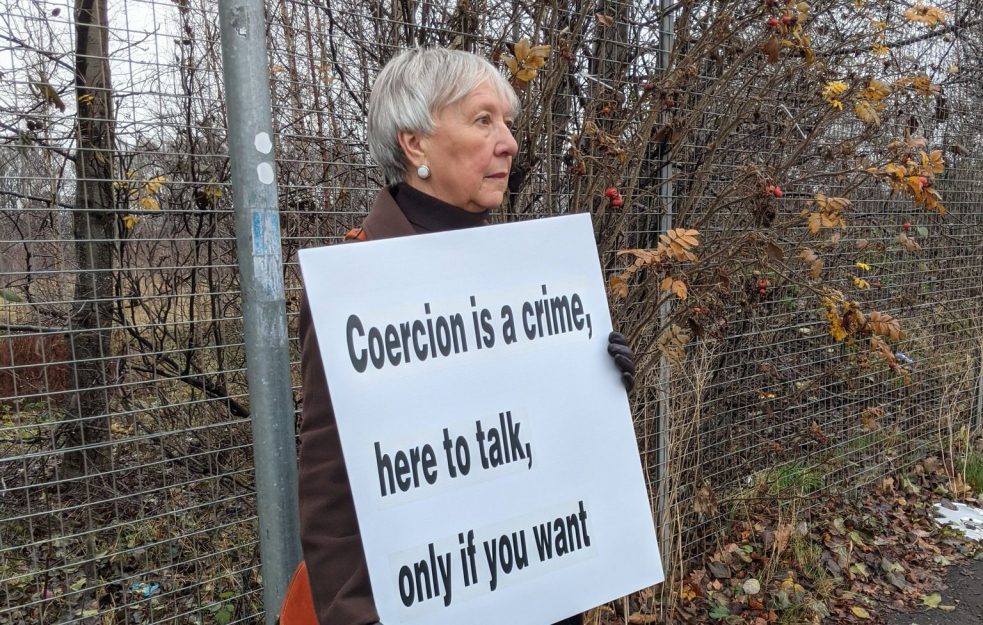
On 27 April, Glasgow Sheriff Court dismissed criminal charges against a Christian woman, Rose Docherty, who had been arrested for peacefully offering consensual conversation within a designated “buffer zone”, finding that the prosecution had failed to disclose an offence. However, the case may be reopened if prosecutors present further evidence. Docherty was the first person charged under Scotland’s 2024 “buffer zone” law after standing near a Glasgow hospital with a sign reading: “Coercion is a crime, here to talk, only if you want.”
Docherty had been arrested after standing near the hospital holding the placard, without approaching individuals or engaging in conduct described as obstructive or intimidating (OIDAC reported). She is the first individual to be charged under the Abortion Services (Safe Access Zones) Act, introduced in 2024, which prohibits activities within 200 metres of clinics that could influence or alarm individuals accessing or providing abortion services, as well as behaviour that may cause harassment, distress, or obstruction.
At a hearing on 20 April, Docherty’s legal representatives from ADF UK argued that the charges did not meet the requirements of the legislation. They submitted that the prosecution had failed to identify any individual within the zone who had been influenced by her conduct, which they argued was a necessary element of the offence. During the same hearing, the prosecution acknowledged that such a person would be required to establish the offence and indicated that enquiries were ongoing.
In its decision on 27 April, the court concluded that the prosecution had “failed to disclose an offence known to the law of Scotland” and dismissed the case pro loco et tempore, meaning it could be reopened if further evidence were presented and a prosecution considered appropriate.
Docherty had previously stated that she did not believe she was breaking the law, explaining that she was present to speak with individuals only if they wished to engage and that she did not approach anyone or behave in a manner that was intimidating or harassing.
While the dismissal of the charges represents a clear legal outcome in her favour, it does not negate the impact of the proceedings on Rose Docherty. She was arrested, detained, and subjected to several months of criminal investigation for offering what she described as a peaceful and consensual conversation. As she noted, the process itself became a form of punishment.
The case also raises concerns about the application of “buffer zone” laws, highlighting the risk that such legislation may be interpreted in ways that restrict otherwise lawful and peaceful forms of expression. In response to the ruling, Docherty stated: “This verdict is a major victory for free speech in Scotland and the UK. It shows that peacefully offering consensual conversation on a public street, which is all I have ever done, can never be a crime.”
Source: BBC, ADF International
Picture (c) ADF International