Opinion: Why Labelling Christians “Extremist” Is Not Only Unfair, but Dangerous
Posted on: September 17, 2026
Country:
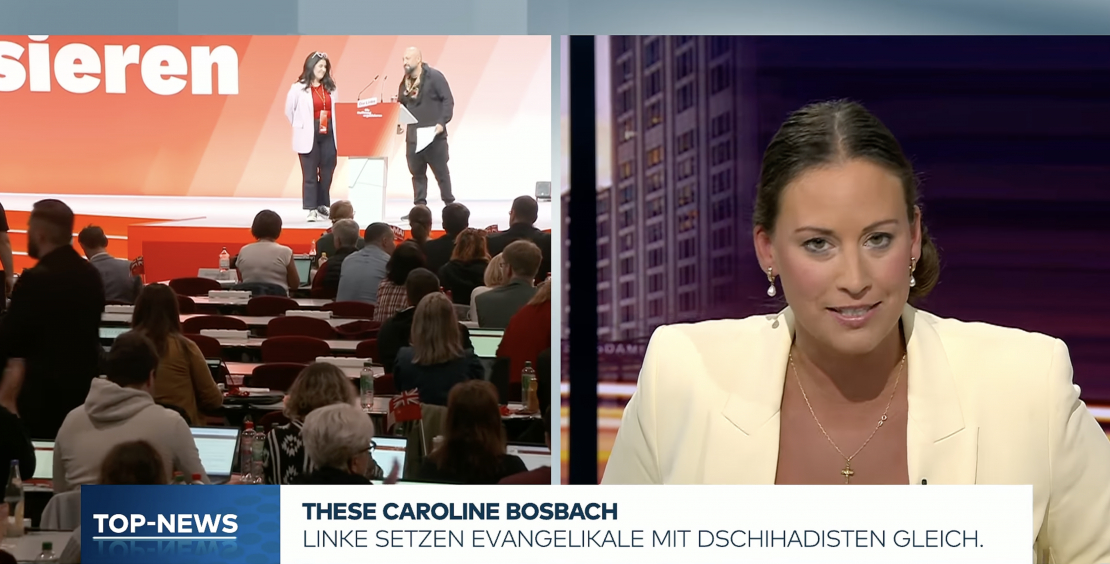
In recent weeks, the labelling of Evangelicals and other Christians who hold traditional Christian convictions as “fundamentalist” or “extremist” – and even placing them rhetorically alongside jihadists – has once again sparked debate in the German-speaking world.
In its election programme in the German state of Saxony-Anhalt, the left-wing party Die Linke pledges to decisively combat “religious fundamentalism, whether Christian-Evangelical or jihadist in character”. The formulation places Evangelicals and jihadists side by side as manifestations of the same phenomenon: religious fundamentalism.
A guest commentary recently published by Austria’s Der Standard employed a similar framing, claiming that “Islamists, the right-wing internet mob, the Russian Orthodox Church and Christian Evangelicals” are “playing in the same league against human rights and democracy”. The article later illustrates the kind of “religious or political extremism” that must be combated, namely “forced marriages, genital mutilation, restrictions on the freedom of girls and women, espionage, violence, terrorism.”
For a practising Evangelical Christian, finding oneself in such company may seem so absurd as to resemble an editorial mistake. Yet this can hardly be dismissed as merely clumsy wording. Too often, “extremist” has become a convenient label for discrediting Christian groups whose actual positions one would rather not engage with.
The comparison with jihadism is particularly grotesque. Jihadist movements have justified terrorism, religious violence and grave violations of fundamental rights. European Evangelical organisations, by contrast, explicitly affirm democracy, human rights and religious freedom and reject coercion, political domination and violence. The European Evangelical Alliance recently reiterated precisely these principles, while warning against simply importing American political categories into descriptions of European Evangelicals.
Germany’s Commissioner for Freedom of Religion or Belief, Thomas Rachel, also issued a statement warning against the defamation of Evangelical Christians by Die Linke: “In Germany of all places, where Pietism and the Enlightenment historically flourished side by side, it is outrageous to accuse Evangelical Christians and churches of a violent and anti-democratic fundamentalism that must be ‘decisively combated’.”
The lable “extremist” is, however, not only unfair; it is, in fact, dangerous. Christians may believe that marriage is the union of one man and one woman, that human life deserves protection from conception until natural death, or that human beings are created male and female. These convictions may be unpopular in parts of contemporary European society. They can be challenged, debated and rejected. But branding their peaceful advocacy – or Christian groups themselves – as “extremist” in order to push them beyond the boundaries of legitimate public debate is profoundly anti-democratic.
Nor do such labels necessarily remain confined to the opinion pages. The recent OSCE/ODIHR guide on anti-Christian hate crime explicitly warns that such crimes “do not happen in a vacuum” and points to the role public discourse and narratives can play in reinforcing prejudice and stereotypes against Christians. Persistent stereotypes can create a social climate in which hostility towards a particular group becomes increasingly normalised.
Germany has recently provided a disturbing example: a Christian café run by an Evangelical church was forced to close after being targeted in 26 attacks, including an attack with butyric acid, by radical left-wing groups opposed to the church’s teachings on marriage and family.
However, the problem is not confined to Germany. Recent surveys among Catholic priests in Poland and Spain, for example, found that an overwhelming majority attributes the rise of experienced aggression and violence to negative or stereotypical media portrayals. In both countries, more than 90 per cent of surveyed priests perceived consistent media bias against Christians, and Catholic priests in particular, which they felt was fuelling aggressive behaviour.
Finally, the inflationary use of the term “extremism” carries another cost: it hollows out the meaning of the term itself. When peaceful disagreement becomes ‘extremism’, the word no longer exposes extremism – it disguises it.