Renewed Push to Remove Vigo Cross Despite Earlier Court Ruling on Its Resignification
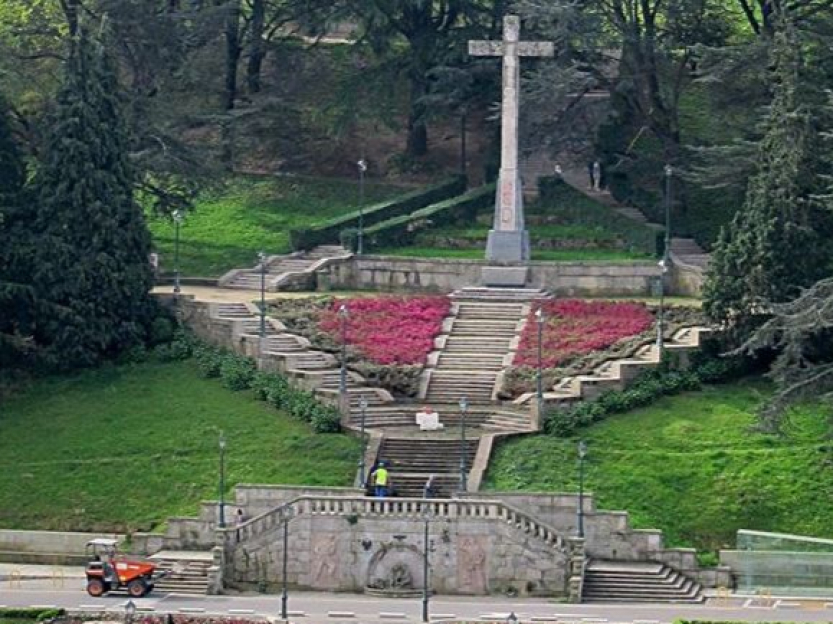
In December 2025, the Galician nationalist party BNG called on the Spanish Government to include the monumental Cross of O Castro in Vigo in the newly established national Catalogue of “Symbols and Elements Contrary to Democratic Memory”, which could lead to its removal. The initiative comes despite a 2015 ruling by the High Court of Justice of Galicia (TSXG), which held that, after political had been removed, the cross no longer constituted an exaltation of the Civil War or Franco dictatorship and could be regarded in its present context as a religious and commemorative monument.
The cross was erected in 1961 as part of a monument commemorating those who died on the Francoist side during the Spanish Civil War. In 1981, however, Vigo City Council decided to reinterpret the monument, and its explicitly political elements—including Falangist symbols, Franco-era coats of arms and inscriptions—were subsequently removed.
After an association campaigning for historical memory sought the removal of the remaining cross, a lower court ordered its removal in 2014. The High Court of Justice of Galicia overturned that decision in 2015. While acknowledging the monument's Francoist origins, the court found that, once “all the fascist symbolism” had disappeared, it no longer represented an exaltation of the dictatorship. Instead, the remaining cross could be understood as a religious symbol “which transcends political ideas” and as a reminder of a historical past “that must not be forgotten”.
Despite this ruling, the BNG renewed calls for the cross's removal in December 2025, shortly after the Spanish government introduced a new Catalogue of “Symbols and Elements Contrary to Democratic Memory”. The party rejected the interpretation of the monument as a religious symbol and argued that its Francoist origins continued to justify its removal.
The renewed dispute highlights concerns about the treatment of Christian symbols under Spain's Democratic Memory policies. While removing symbols that continue to glorify dictatorship serves a different purpose, attempts to remove crosses whose explicit political elements have already been eliminated risk disregarding their present religious character, as the High Court ruling highlights.
Source: larazon.es
2015 High Court Judgement: poderjudicial.es
Image: X