Catholic Youth Representative Reports Religious Discrimination by Scottish Council
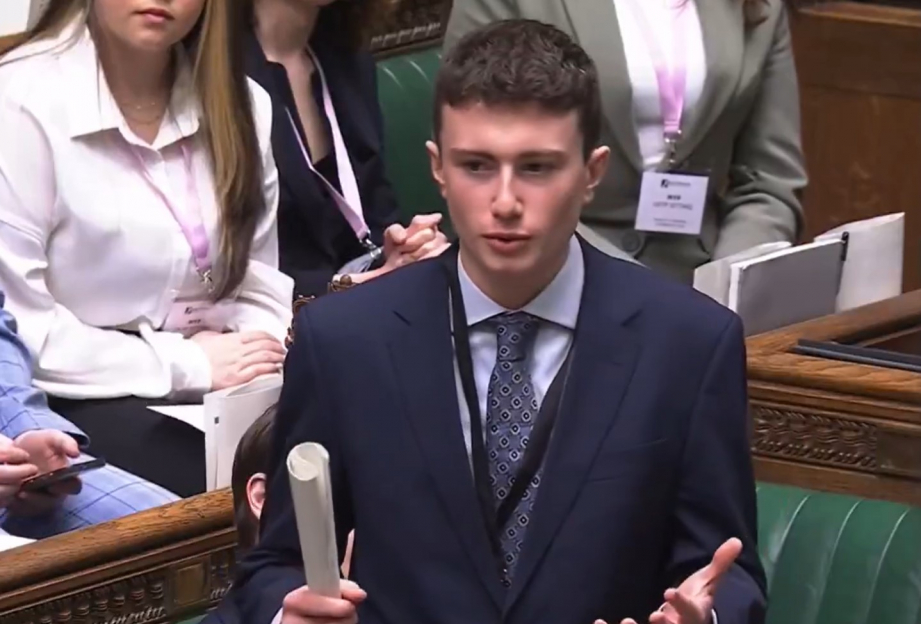
On 13 November 2025, former Scottish Youth Parliament member Matthew Quinn told a CIDAC hearing that Inverclyde Council staff had singled him out because he was Catholic, questioned him about his personal views on abortion and same-sex marriage, and later called him a “religious extremist”. The Council subsequently announced that an externally commissioned investigation had upheld none of his complaints, but refused to publish the £52,750 report or the reasoning behind that conclusion.
Matthew Quinn, a Catholic student from Inverclyde, was 16 when he entered the selection and training process to become a Member of the Scottish Youth Parliament (MSYP). He was elected in February 2024 and represented Inverclyde until his resignation in September 2025. At a hearing held by the Commission of Inquiry into Discrimination Against Christians (CIDAC) on 13 November 2025, Quinn described how assumptions and discrimination due to his his Catholic faith affected his treatment during the selection process and throughout his time as a youth representative.
During candidate training in 2023, two adult trainers questioned Quinn on his personal views on same-sex marriage, abortion and stem-cell research. According to his complaint, other candidates were not asked comparable questions, and the trainers appeared to have made assumptions about his beliefs because he attended a Catholic school. Quinn declined to answer because he did not consider the questions relevant to his ability to represent young people, but said that his refusal was treated as evidence that he was concealing controversial views.
Quinn described himself as a “liberal Catholic” and said that he had not campaigned publicly on abortion, sexuality or other disputed moral questions. Nevertheless, he reported that a Council department head later described him as a “radical militant” in an internal Microsoft Teams exchange and that another employee called him a “religious extremist” at a youth centre, in the presence of two trainers. According to Quinn's report, publicly identifying as Catholic was treated as evidence of political or ideological extremism.
Quinn also reported attempts to prevent him from standing as an MSYP before the election. Despite this opposition, he was elected following a contest involving five candidates and subsequently began representing young people in Inverclyde. During his term, however, he said that criticism of Council taxation, spending and staff salaries led to his social-media posts being reported to the Scottish Youth Parliament on at least ten occasions. He maintained that rules governing public statements were applied more strictly to him than to other youth representatives.
The dispute later developed into disciplinary complaints accusing Quinn of bullying and harassing Council employees. According to his CIDAC testimony, those complaints were eventually dismissed, but he was not invited to give evidence during the process. He was also called to a meeting with four Council employees without being allowed to bring a representative. Quinn declined to attend because of emotional distress and his experience during previous meetings, and further reported that a senior Council official had threatened him with physical violence.
In May 2024, Quinn submitted a detailed complaint to Inverclyde Council and the Scottish Youth Parliament covering anti-Catholic treatment, hostile comments and other conduct he had experienced. He said that the concerns were not properly investigated at the time. He also reported that the Inverclyde Labour Group’s social-media account had used photographs of him in posts he considered cyberbullying. The Labour Party’s National Executive Committee later informed him that some form of action had been taken, although he was not told what that action involved.
Quinn resigned as an MSYP in September 2025. He said that the immediate catalyst was an email suggesting that his possible removal could be justified by concerns about his mental health and the effect of the dispute on Council employees. In his resignation statement, he described a “toxic culture” in which he had been systematically undermined and said that the handling of his complaints had left him unable to continue in the role. At the CIDAC hearing, he explained that he believed religious discrimination had operated alongside political retaliation and expressed concern that an investigation commissioned by the Council would leave the authority effectively “marking its own homework”.
Inverclyde Council commissioned an external investigation supported by a law firm. On 4 June 2026, the Council announced that the investigation had upheld none of Quinn’s complaints. However, the Council subsequently refused to disclose the final report, its executive summary, methodology or detailed assessment of the evidence, citing confidentiality and legal professional privilege. The investigation reportedly cost £52,750 plus VAT.
Quinn has called for the report to be published, stating that he has nothing to hide. The Council’s refusal means that the public cannot see how the reported anti-Catholic comments were addressed, how conflicting accounts were assessed or why the investigator concluded that none of his complaints should be upheld. It also leaves unanswered why a young Catholic representative who entered public life at the age of 16 was questioned about controversial moral issues, described as a “religious extremist” and “radical militant” despite making to public comments on those matters, subjected to repeated disciplinary processes and ultimately felt compelled to resign.
Source: CIDAC, Greenock Telegraph, Glasgow Guardian
Image: House of Commons